
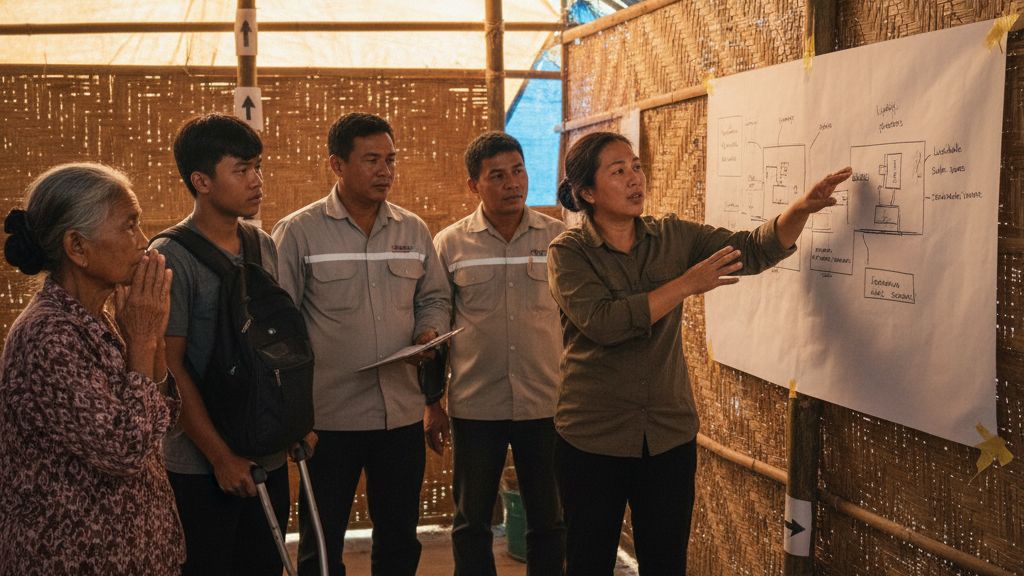
When women, people with disabilities and other gender groups are invited into the meeting, but excluded from the decision.
Gender Equality, Disability and Social Inclusion (GEDSI) is a crosscutting principle. It should be mainstreamed across the project life cycle and applied across themes, from health and governance to climate resilience and disaster response.
However, in my last eight years working across Indonesia, Myanmar, Cambodia, and Sri Lanka, I often saw GEDSI positioned as secondary, unseen, under-funded, unimportant and sometimes treated as “nice to have.”
From commitment to system: building a GEDSI strategy
In Sri Lanka, under the USAID program, I led the organizational capacity development division with local staff. Our role was challenging: strengthening local partners’ organizational capacities toward stronger governance and performance, particularly on the compliance to the GEDSI principles.
A key part of the program was supporting the development of a GEDSI strategy for a multi-year context. This strategy was designed to guide the program with practical components: contextual analysis, action planning, and baseline to endline measurement of GEDSI implementation.
To help teams operationalize GEDSI, we built a phased pathway:
- Consensus building
- Capacity strengthening
- Application
- Institutionalization
This approach was not new for me. I previously applied a similar model with more than 20 local organizations in Indonesia under USAID LINKAGES–EpiC, where I oversaw capacity development for community-based organizations working with transgender communities, sex workers, men who have sex with men, and people who inject drugs.
The measurement problem: participation is not empowerment
One area I contributed strongly is strengthening how we define and measure women’s empowerment, especially in complex and sensitive contexts such as malaria, tuberculosis, HIV AIDS elimination, conflict settings, trauma healing, investigative journalism, and internally displaced communities.
Many programs still measure gender integration through participation numbers:
- how many women attend training,
- how many women join meetings,
- how many women are listed as members.
Participation data is important, but it is not enough. Counting women’s attendance does not automatically reflect empowerment. If we are serious about women’s leadership and community resilience, we must measure influence, agency, and meaningful access to resources.
A practical frame: representation, influence, and access
I frame women’s empowerment as progress across three connected dimensions:
1) Representation. Women’s presence in decision-making structures. Representation matters, but it can hide symbolic roles. Women may be “included,” but not trusted to lead decisions, especially in men-dominated spaces.
2) Influence. Women’s ability to shape outcomes. Influence is not always visible in formal documents, it is relational and contextual. This is why I often combine perception-based tools (simple scaled survey questions) with evidence from monitoring systems (minutes, decisions, action logs).
In disaster management, for example, women may be members of village disaster forums, but key command roles such as incident commander, operations, logistics, and security coordination are still commonly assigned to men. Women are consulted, but the decisions remain unchanged. Even practical safety inputs about shelter lighting, lockable spaces, sanitation, and safe sleeping arrangements can be treated as “comfort issues,” not protection requirements.
3) Access. Women’s control over resources and benefits. Access is not only about being enrolled in livelihood or resilience programs, but about whether women sustain control over benefits. For example, measuring how many women independently manage income from enterprises gives deeper insight than counting training attendance. In health programming, access can include whether women and LGBTQI communities can seek healthcare safely and independently without barriers or coercion.
Institutionalization: making GEDSI sustain
From a capacity development perspective, I work across three levels: individual, community, and organization and GEDSI must live beyond all three.
In practice, I typically start with a technical and organizational assessment, followed by a tailored action plan. Smaller civil society organizations often focus GEDSI only at activity level, while governance systems and monitoring remain weak. Thus, institutionalization is the other name for localization, ensuring sustainability of good governance and compliance to GEDSI principles.
To institutionalize GEDSI, I mentor teams to develop:
- policies and safeguarding protocols,
- standard operating procedures,
- job aids and tools,
- routine monitoring and reflection mechanisms.
Because GEDSI is sustainable when it becomes part of “how we work,” not only “what we report.”
If we want inclusive outcomes, we must stop treating GEDSI as a checkbox. We need to measure what matters: who influences decisions, who controls access to resources, and how inclusion is embedded into systems.
(AI disclosure: AI is used to clarify writing's structure, overall idea and majority of writing style is authentic from writer's working experiences and perspectives).